
The Restaurateur Who Chose Freedom Over Fast Growth
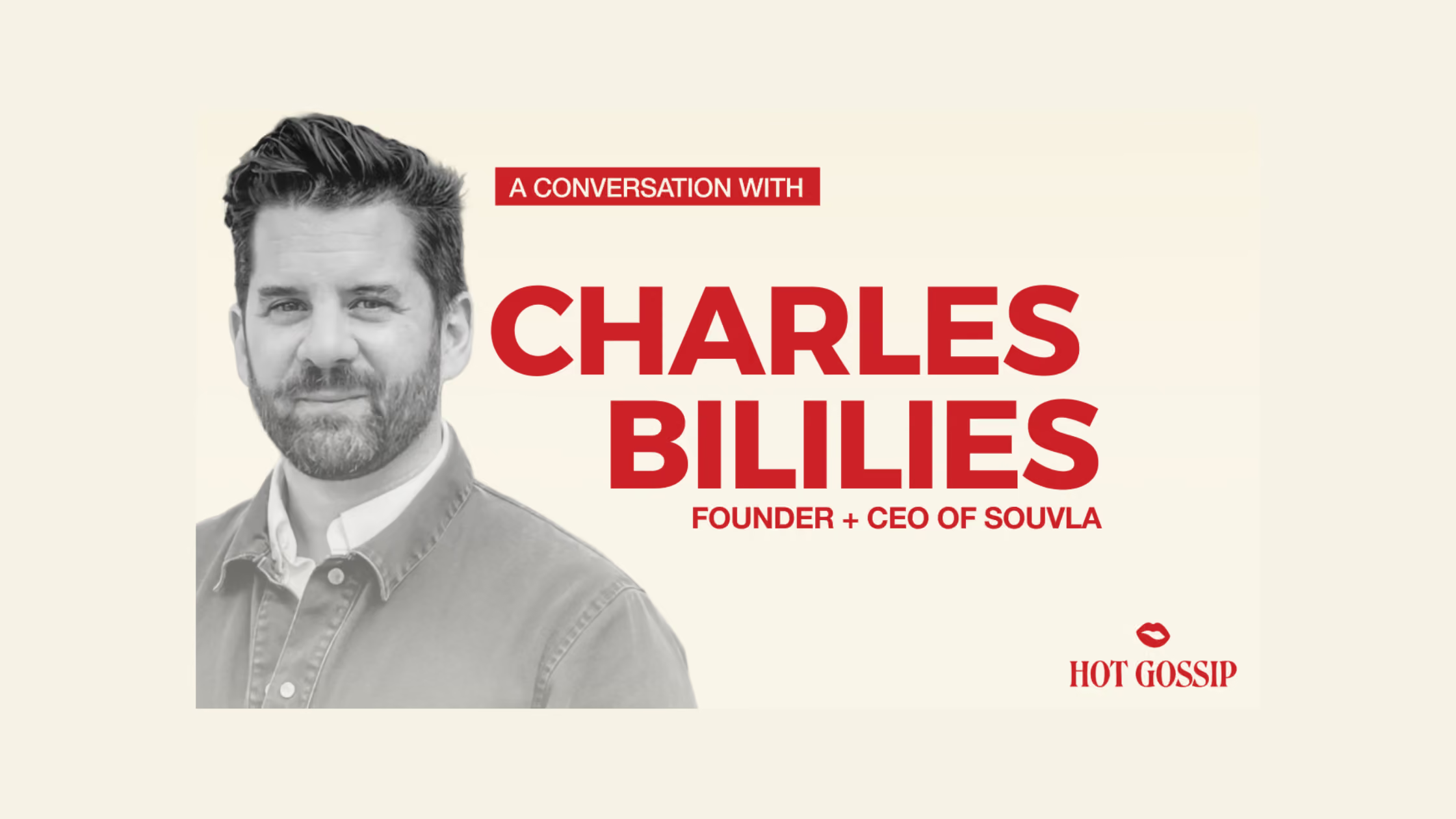
Charles Bililies built Souvla, one of San Francisco's most beloved restaurant groups, by rejecting almost everything the industry says you're supposed to do. No institutional capital. No rushed expansion. No compromising on team development to hit growth targets.
For 11 years, he's grown deliberately, saying no to private equity checks and staying completely independent. While competitors chase rapid scale and exit strategies, Charles has built a business on his own terms—one where freedom matters more than awards, where team readiness determines expansion timing, and where Greek hospitality values translate into modern operational excellence.
His journey from a backyard lamb roast to multiple locations reveals something crucial about sustainable hospitality: the restaurants that last aren't the ones that move fastest. They're the ones that build deepest.
The Backyard Lamb Roast That Became a Restaurant
Charles didn't set out to revolutionize fast-casual dining. He was working in fine dining, and his family hosted a Greek Easter celebration—the kind where you roast a whole lamb in the backyard.
His then-girlfriend (now wife) suggested: "Why don't we do this as a business?"
The idea seemed impossible. Tacos had sit-down restaurants. Burritos had sit-down restaurants. But roasted meats? That was street food, counter service, grab-and-go. Nobody was doing Greek-style roasted proteins as a full-service dining experience.
"We wanted to take what is typically found at a taqueria or a burrito shop and make it a sit-down experience," Charles said. "Composed plates. Intentional simplicity. Everything we learned from fine dining, but accessible."
The first Souvla opened without a clear blueprint. They were inventing the category as they went—fast-casual Mediterranean done with the care and composition of fine dining, but without the pretension or price point.
What made it work wasn't just the food. It was Charles' background in fine dining colliding with Greek hospitality traditions. That combination created something neither genre had on its own: accessible sophistication.
The Capital Problem Nobody Talks About
When Charles decided to open Souvla, he faced the reality every first-time restaurateur hits: nobody wants to fund you.
"I had no track record," he said. "I'd worked in restaurants, but I'd never opened one. I'd never run one. Why would anyone give me money?"
He pitched friends and family. Small checks came in—$5,000 here, $10,000 there. Enough to barely get started, but nowhere near what he needed.
Then he did something most first-time operators can't do: he raised debt, not equity. He convinced lenders that fast-casual Mediterranean could work, even though the category didn't really exist yet.
"I raised about $600,000 in debt for the first location," Charles said. "That meant I owned the business, but it also meant if we failed, I was personally liable for everything."
That pressure shaped everything about how Souvla operates. When you're personally on the hook for six figures, you can't afford to be precious about anything except what actually works.
Most restaurateurs with institutional backing can experiment more freely. They have runway. Charles had to get it right from the start, or lose everything.
That constraint became an advantage. It forced operational excellence from day one.
Why He Turned Down Private Equity
After Souvla proved the concept worked, private equity firms started calling.
The offers were real. The checks were big. The path to rapid expansion was clear.
Charles said no.
"Freedom is more important and more powerful than money or awards," he said. "Once you take institutional capital, you're on their timeline. You expand when they say expand, whether your team is ready or not. You exit when they need to exit, whether you want to or not."
He'd watched other fast-casual concepts take PE money and grow from three locations to thirty in two years. Some succeeded. Many imploded—great concepts destroyed by growth that outpaced their operational capacity.
"I saw teams get stretched too thin," Charles said. "Managers who weren't ready getting promoted because they needed bodies. Quality dropping because nobody had time to train properly. Cultures dissolving because the people who built it were spread across too many locations to maintain it."
That's not the business he wanted to build.
Instead, Souvla has grown to seven locations over 11 years. Slow by industry standards. Intentional by Charles' standards.
"We only open a new location when two things align perfectly: we have the right real estate, and we have a team that's ready to run it," he said. "If one of those is missing, we wait."
That patience is the opposite of how venture-backed hospitality works. But it's also why Souvla hasn't had a single location close in over a decade.
The Professional Kitchen Culture Problem
Charles came up in fine dining during an era when kitchen culture was, in his words, "pretty toxic."
Yelling. Ego. Hierarchy enforced through humiliation. The old guard European model where abuse was justified as "how you toughen people up."
"I learned incredible technique and discipline from fine dining," Charles said. "But I also learned what not to do with people."
When he built Souvla, he kept the technical excellence and operational rigor from fine dining. He left behind the toxic culture.
That meant transparency where fine dining had been secretive. Shared financial information where fine dining had hoarded it. Development pathways where fine dining had gatekeeping.
"Restaurants have become a lot more professionalized," Charles said. "Fifty years ago, it was where unemployable people ended up. Now you can actually build a career. Line cook to sous chef to chef de cuisine to leadership. Those paths exist now."
But only if operators invest in creating them.
At Souvla, Charles implemented open-book management. Every manager sees the P&Ls. Everyone understands food cost, labor cost, rent. The numbers aren't mysterious—they're shared.
"When people understand the business, they make better decisions," he said. "They're not just following orders. They're thinking like operators."
That approach challenges the old kitchen model where information was power and chefs ruled through mystery. Charles believes the opposite: transparency creates better operators, which creates better businesses.
Greek Hospitality in Modern Operations
Charles' Greek heritage shows up everywhere in how Souvla operates, even if it's not obvious from the outside.
Greek hospitality has a specific quality—warm but not performative. Generous but not transactional. It's about making people feel taken care of without making a show of it.
"In Greek culture, when someone comes to your home, you feed them," Charles said. "It's not about impressing them. It's about making sure they're comfortable, they're satisfied, they feel welcome."
That philosophy translates directly to how Souvla trains staff. Hospitality isn't scripted interactions or forced enthusiasm. It's genuine care for whether people leave satisfied.
The Greek influence also appears in how Souvla thinks about food. Greek cooking is about quality ingredients, simple preparation, letting flavors speak for themselves. No unnecessary complexity. No technique for technique's sake.
"Composed sets and simplicity—that's Greek cooking," Charles said. "You don't need fifteen ingredients when three perfect ones will do."
That restraint is rare in an industry that often confuses complexity with sophistication. Souvla's menu has stayed remarkably consistent for 11 years because the fundamentals work.
What Customers Actually Want
After 11 years, Charles has learned something that surprises a lot of operators: customers don't always want innovation.
"People just want more Souvla," he said. "They don't want us to reinvent the menu every season. They don't want limited-time offers. They want the thing they love, done well, every time."
He compares it to going to see a band in concert. "If they only play deep cuts and skip all your favorite songs, you leave disappointed. Sometimes you just want the hits."
This insight challenges the constant innovation pressure in modern restaurants. Social media rewards novelty. Food media celebrates change. Investors want to see evolution.
But actual customers? They often just want consistency.
"We'll add something new occasionally," Charles said. "But our core menu hasn't changed much in 11 years because that's what people come for. The lamb. The chicken. The Greek fries. Why mess with it?"
That confidence to resist innovation pressure comes from owning the business completely. If Charles had institutional investors, they'd be pushing for menu changes, seasonal offerings, anything to create newness for newness' sake.
Instead, he can focus on doing the same things exceptionally well, repeatedly.
The Fires, Literally and Figuratively
Running restaurants means constant crisis management. Equipment fails. Staff calls out. Suppliers deliver the wrong order. Health inspections happen. Grease traps need servicing mid-shift.
Charles has learned to stay unemotional about chaos.
"I've had a restaurant catch on fire twice," he said. "It's just like, okay. What do we do? How do we fix it? How do we keep serving?"
That equanimity isn't natural—it's built through years of managing unpredictability.
The first time most operators face a major crisis, they panic. The fiftieth time, they've developed systems and emotional resilience to handle it without falling apart.
"You can't be precious about problems in restaurants," Charles said. "They're going to happen. Every single day, something goes wrong. If you lose your mind every time, you won't survive."
That resilience is what separates operators who last from those who burn out in three years. Restaurants require a specific kind of toughness—not aggressive or domineering, but steady and adaptive.
Charles' team has absorbed that approach. They don't panic when things go wrong. They fix it and move on.
Building Teams That Don't Need You
Charles' long-term goal isn't to work in restaurants forever. It's to build a business that runs without him.
"I want to mentor the next generation of restaurateurs," he said. "People who can take what we've built and run with it. That only happens if I'm not the bottleneck."
That means radical transparency about operations. Shared financial literacy. Development pathways that are clear and achievable.
Most restaurant groups centralize knowledge in the founder. Charles is actively decentralizing it.
"When managers understand the full business—not just their department, but the whole P&L—they can step into bigger roles," he said. "They're not just executing my vision. They're capable of creating their own."
That approach takes longer to build. It's easier to keep control, make all decisions yourself, stay indispensable.
But it doesn't scale. And it definitely doesn't create the next generation of leaders.
Charles is playing a different game: building a restaurant group that becomes a training ground for future operators. People who learn not just how to cook or manage a floor, but how to run a sustainable hospitality business.
The Freedom Question
At the core of Charles' approach is one question: What's the point of building a business if you lose your freedom?
"I could have grown faster with institutional capital," he said. "I could have thirty locations by now. But I'd also be on someone else's timeline, answering to people who care more about exit multiples than building something sustainable."
That freedom isn't just philosophical. It's practical.
Charles can decide to wait on expansion if the right team isn't ready. He can turn down real estate that doesn't feel right. He can maintain menu consistency because his customers want it, not change it because investors want novelty.
He can build the business that aligns with his values, not the business that maximizes investor returns.
"Awards and recognition are nice," Charles said. "But they're not why I do this. I do this because I get to build something on my own terms, with people I respect, in a way that feels sustainable."
After 11 years, Souvla hasn't had a single location close. The team has stayed remarkably stable. The culture has held.
Those outcomes don't happen by accident. They happen because Charles prioritized sustainability over speed, depth over scale, autonomy over capital.
What Building Right Looks Like
Most restaurant coverage focuses on the outliers—the rapid expansion stories, the celebrity chef empires, the concepts that go from one location to fifty in three years.
Charles represents something quieter but more common among restaurants that actually last: steady, intentional growth. Deep team development. Operational excellence as the foundation. Freedom maintained at all costs.
It's not as flashy. It doesn't make the same headlines.
But it's how you build a restaurant group that's still opening locations after 11 years, still maintaining quality, still developing people into better operators.
Souvla works because Charles never confused growth with success. He built something sustainable first, then grew it carefully.
The industry needs more of that approach. Not everyone's going to turn down private equity. Not everyone has the luxury of raising debt instead of equity. Not everyone can grow as slowly as Charles has.
But everyone can ask the freedom question: What's the point of building this if I lose control of it?
For Charles, the answer has been clear from the start. Freedom isn't a luxury. It's the whole point.
Listen to the full conversation with Charles Bililies on Hot Gossip: https://open.spotify.com/episode/2BN0WtCsrwWYzDZjq2nJtm?si=5b41ab59d7bd4a7f
Follow Charles and Souvla: @souvla on Instagram | souvla.com