
The 34th Row: What Shore Gregory and Jeremy Sewall Built When They Decided Not to Scale
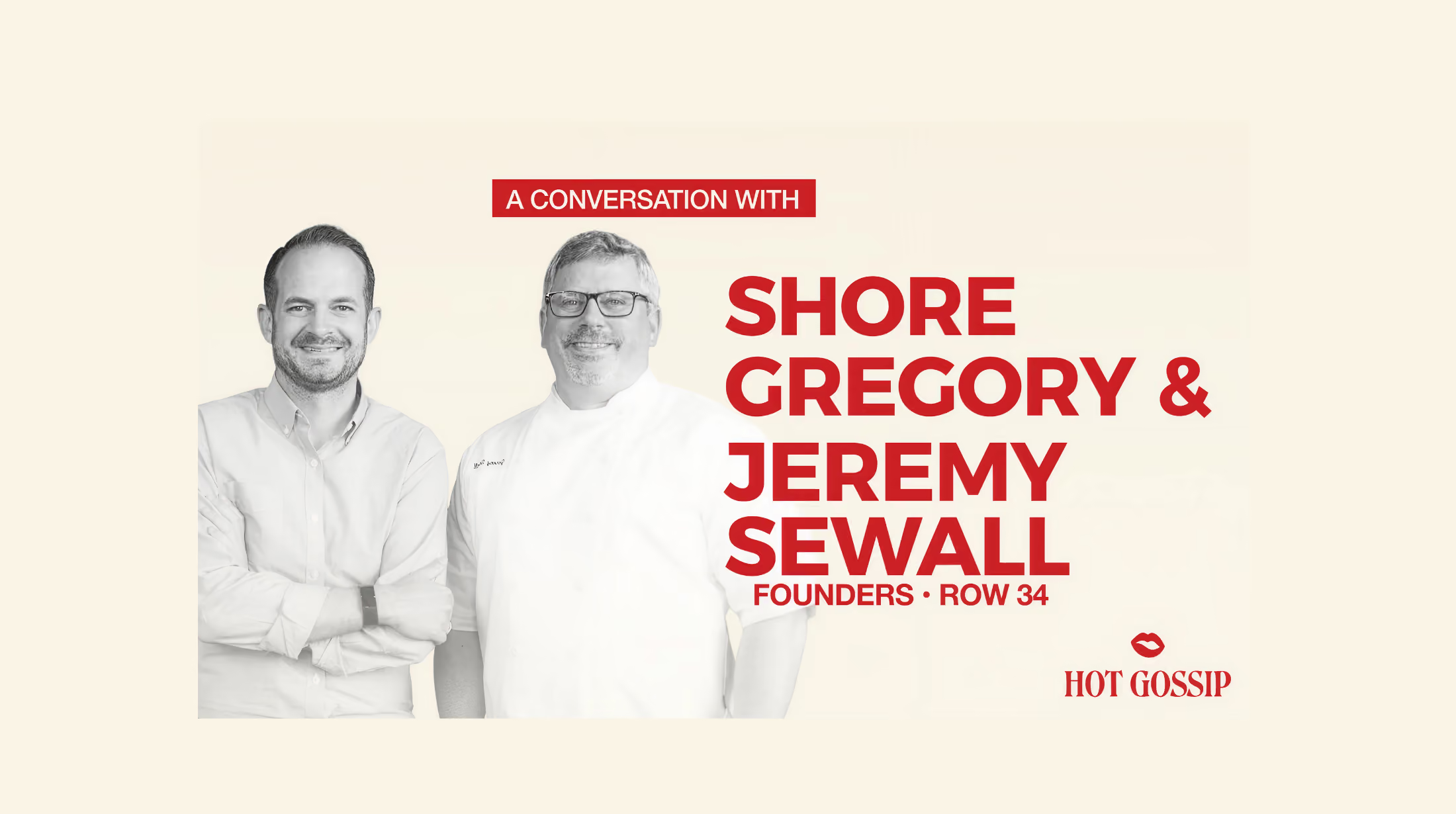
There is a row in an oyster nursery in Duxbury, Massachusetts, where everything started. Skip Bennett, the founder of Island Creek Oysters, was experimenting with a new growing technique, cages just above the ocean floor instead of planted directly on the bottom. The experiment happened to be in the 34th row of his nursery. The name of the restaurant was that simple, and it has stayed exactly that honest ever since.
Shore Gregory and Jeremy Sewall have been running Row 34 together for more than a decade. They now have five locations, a management team that has been with them since nearly the beginning, and a sourcing infrastructure built around driving their own truck. They are, by any measure of the hospitality industry, a success story. But what makes them interesting is not what they've built. It's what they've consistently chosen not to do.
How They Got There
Shore's path into restaurants started at Island Creek Oysters, where he worked to build the brand and eventually help grow its consumer-facing side. Jeremy was one of Island Creek's first restaurant customers, the first chef ever to visit the farm. When Skip Bennett began experimenting with cage-grown oysters in that 34th row, Shore and Jeremy were already in conversation about what would eventually become the restaurant.
Jeremy came to the partnership after years of cooking in Maine, Europe, and the Bay Area, where California's farm-to-table movement fundamentally changed how he thought about sourcing. He brought that sensibility back to Boston when he and his wife opened their first restaurant in Brookline in 2006. The idea was always to cook food that felt honest, ingredients you knew, from people you trusted, prepared in a way that let the product speak.
Island Creek Oyster Bar opened in 2010 and exceeded every expectation. Three years later, Row 34 opened, conceived as something simpler and more scalable, without the daily-printed menu and the constant improvisation that made Island Creek such a demanding operation. The name honored where it started: not a brand story manufactured in a conference room, but the literal geography of a single experiment in a Massachusetts bay.
Responsible, Not Sustainable
Jeremy has a precise reason for using the word "responsible" instead of "sustainable." The United States, he explains, has the most heavily managed oceans on the planet. The fishermen he works with are operating legally, working hard under real regulatory constraints, and bringing local seafood to market as their livelihood. To call their catch "unsustainable" would be both inaccurate and unfair. What Jeremy can do is choose to support the best of what's available, local day-boat fishermen as much as possible, direct sourcing from people he knows, and a truck that drives to Maine to pick up lobster from Jeremy's cousin Mark rather than buying off a distributor sheet.
"I'm just a conduit," Jeremy says. "I get the product, I put it on the menu, and we celebrate that with the guests." When a local fisherman calls to say he's caught a bluefin tuna and wants it on the menu at Row 34, Jeremy buys it. That moment, the fisherman, the kitchen, the guest, is what Row 34 is for. The word "responsible" names the whole chain of decisions that makes that moment possible.
The Economics of Doing It Right
Shore describes the current pricing environment as "a highwire act." Costs are elevated. Consumers are fatigued. And restaurants like Row 34, which have committed to sourcing in a way that is deliberately more expensive and more labor-intensive than the alternatives, face a particular version of this squeeze.
The lobster roll is the clearest example. It costs what it costs because of how they make it: driving to Maine for the lobster, shucking it in-house, breaking it down in the restaurants. When the price of lobster rises, the price on the menu rises with it. Row 34 tried taking it off. Their guests were more upset by its absence than by the price. The solution, Shore says, is not to compromise on the product or hide the cost, it's to make sure that everything else on the plate, and in the room, is meeting or exceeding what guests expect to receive in exchange. "Do fewer things better" is how he puts it. Master what you do, then execute at a level where the value is self-evident.
Building a Team That Stays
Row 34's management team has been with Shore and Jeremy for eight to ten years. Some of the line staff have been there since the beginning. One host left to make more money somewhere else and came back. Jeremy has people he's worked with in Boston for twenty years, including his culinary director Ryan, who he hired as a teenager.
Neither Shore nor Jeremy attributes this to any particular strategy. What they describe, instead, is a set of instincts that seem to compound over time. Don't overpromise. Give people autonomy. Let them fail and help them through it. Show up at the dish station yourself when the restaurant is short-staffed, which Jeremy did, on Mother's Day, at his New Hampshire location, for hours, because the team needed a dishwasher and he was the one who could be there.
Shore is precise about one piece of the language: they do not call themselves a family. They are a team. The distinction matters because the word "family" can create dynamics that muddy professional relationships in ways that ultimately don't serve anyone. "We're an amazing team of people," Shore says. "That's what we are." The clarity of that framing, held by everyone from the directors to the floor staff, seems to be part of what makes the whole thing work.
When Jeremy closed the leadership day, a daylong workshop with the organization's directors, general managers, and chefs, he said one thing to the room: "If you need anything and you're stuck, call me." That accessibility, in a group with five locations and a significant headcount, is not something that happens without intention. It is, Shore suggests, what the culture drafts off of.
What Stays
Shore says something near the end of the conversation that lands differently after everything that came before it. When he was twenty-five, he wanted the biggest business they could possibly create. The desire to build something was real, but it was also naive, satisfying some abstract measure of scale rather than any particular vision of what the business should be.
What Row 34 actually is, more than a decade on, is something he describes as an organization that means something to the neighborhoods it's in. Each location has its own identity. The sourcing is the same. The team culture is the same. The name still refers to a row of cages in Duxbury Bay where something new was being tried.
"It's cool," Shore says, "twelve, thirteen years into Row 34, to still feel that way."
• Listen to the full conversation with Shore Gregory and Jeremy Sewall on Hot Gossip → https://creators.spotify.com/pod/profile/hot-gossip-podcast
• Follow Shore, Jeremy and Row 34 on Instagram → @shoregregory & @jeremy_sewall & @row34
• Hot Gossip is hosted by Hannah Collins Tate and Jacob Cross → https://www.thisisroy.com/podcast