
Taste Is the Difference: Why Great Restaurants Are Felt, Not Just Seen
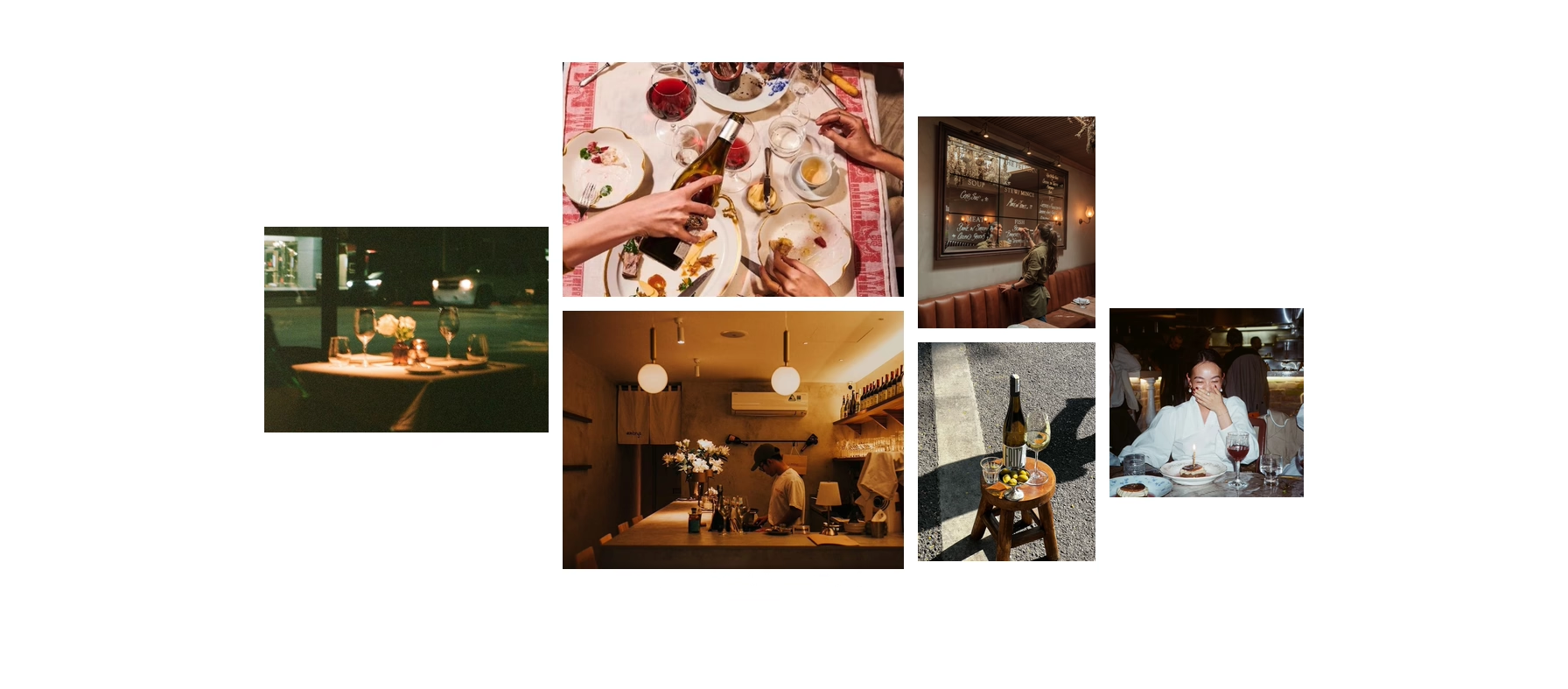
Good Taste Builds Great Restaurants. But what does good taste actually mean in restaurant interior design and branding?
You know it when you walk in.
The lighting is just right. The music feels like someone actually chose it. The bartender has a point of view. The menu makes you curious. Nothing is trying too hard, yet somehow, everything works.
You haven't even ordered, and you already know you want to come back.
That's taste.
And in a hospitality landscape increasingly defined by Instagram-ready interiors, algorithm-driven aesthetics, and copy-and-paste concepts, taste might be the most important competitive advantage a restaurant can have.
Because beautiful is easy to recognize. But memorable is something else entirely.
The Jewel Box vs. The Big Box: Restaurant Design at Any Scale
There's a difference between a restaurant that's designed to impress and one that's designed to connect.
Think about the jewel box restaurant. Maybe it's 30 seats, tucked away on a side street, with mismatched vintage chairs, a perfectly imperfect bar, and lighting that makes everyone look like someone worth knowing.
Now think about the big box. Hundreds of seats. Impressive finishes. Expensive furniture. A dramatic entrance. Every design decision calculated to communicate scale, spectacle, and success.
Both can be beautiful. Both can be successful.
But only one might make you feel like you've discovered something.
And that's the distinction worth exploring.
A jewel box isn't a size. It's a sensibility.
A 200-seat restaurant can have the intimacy of a neighborhood institution. A 20-seat restaurant can feel soulless. What separates them isn't the budget or footprint, but the intelligence and intention behind every decision.
Great restaurant design isn't about how much you put into a space. It's about knowing what belongs there, what doesn't, and why.
Taste Is Not a Trend. It's a Point of View.
Somewhere along the way, hospitality design became increasingly homogenized.
The same curved banquettes. The same sculptural pendants. The same terrazzo. The same muted palettes and vaguely European references.
Individually, these things can be beautiful. Together, without a point of view, they become a formula.
And formulas don't create culture.
Taste is the ability to distinguish between what's fashionable and what's meaningful. It's knowing when to embrace an unexpected color, an inherited piece of furniture, a provocative illustration, or an unconventional material.
It's also knowing when to leave something alone.
The best restaurants have an editorial sensibility. Like a great magazine, every element belongs to a larger story, even when the elements themselves seem contradictory.
High and low. Old and new. Refined and irreverent.
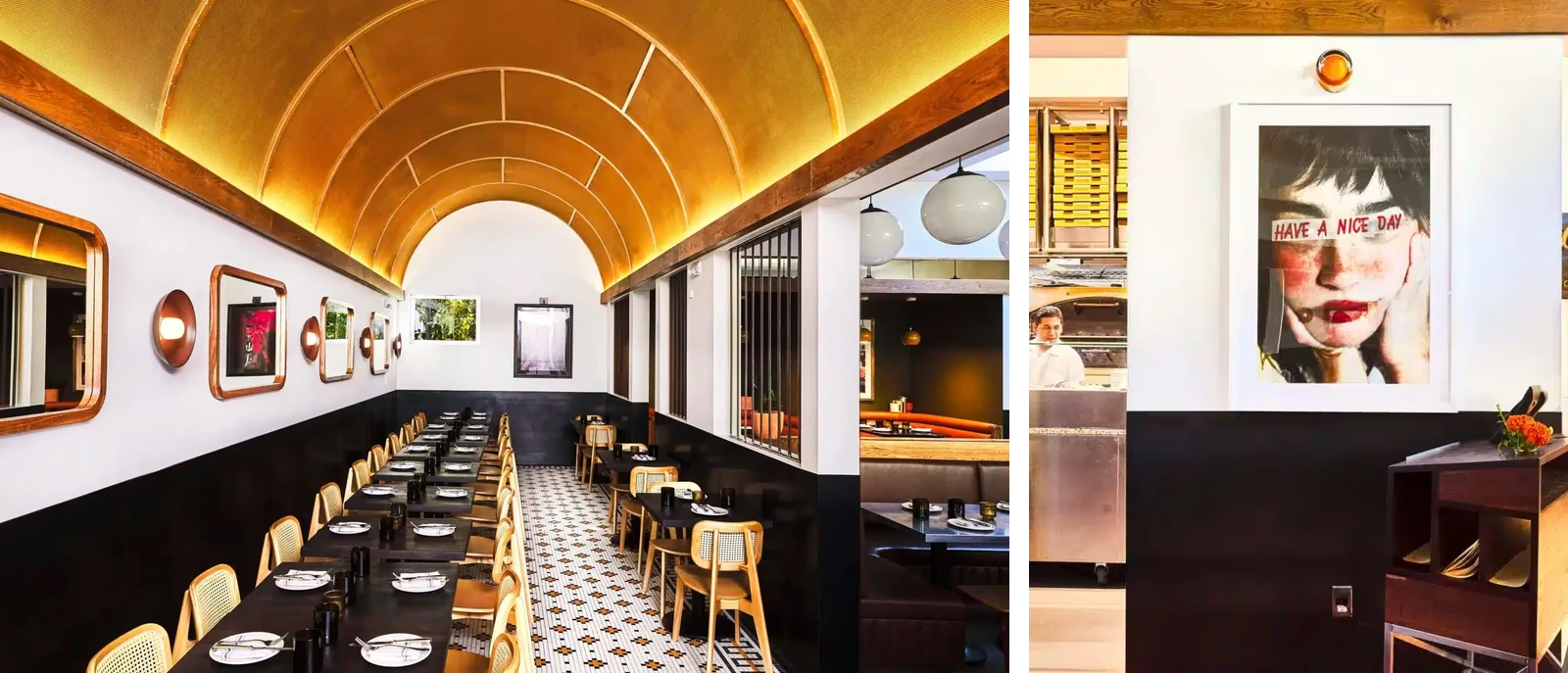
At Delfina, a Mission essential we redesigned, the original Jarrah floors stayed, patched with concrete next to new mosaic and terrazzo, under a glowing brass arch and the owners' own art collection.
The tension makes things interesting.
Good taste isn't about having more. It's about knowing better.
Hospitality Is Human. Restaurant Design Should Be Too.
Restaurants aren't museums. They're places where people fall in love, celebrate promotions, break up, reconnect with old friends, and become regulars.
Yet too many spaces are designed primarily for how they photograph rather than how they feel when they're full of people.
The most compelling restaurant interiors understand human behavior.
They consider how strangers interact at a bar. Why certain corners become everyone's favorite table. How lighting changes the energy of a room. Why a slightly crowded dining room can feel more exciting than a perfectly spaced one.
They understand that atmosphere isn't simply an aesthetic achievement. It's a social one.
A great restaurant gives people permission to be themselves, or perhaps to become a slightly more interesting version of themselves.
That's where branding and interior design intersect.
The brand establishes the personality. The space gives it physical form. The hospitality brings it to life.
And when all three work together, something powerful happens.
The restaurant stops feeling designed and starts feeling alive.
The Beauty of Being a Little Imperfect
In an age of AI-generated imagery, digitally perfected interiors, and increasingly interchangeable aesthetics, the human touch is becoming more valuable.
A handwritten special. A vintage mirror with a little wear. A menu illustration that feels distinctly personal. A collection of objects that looks accumulated rather than purchased in one afternoon.
These details carry something a perfectly rendered space often cannot: evidence of a life lived.
We're not suggesting that every restaurant should look distressed or deliberately unfinished. Manufactured imperfection is just another aesthetic formula.
Real character comes from choices with meaning.
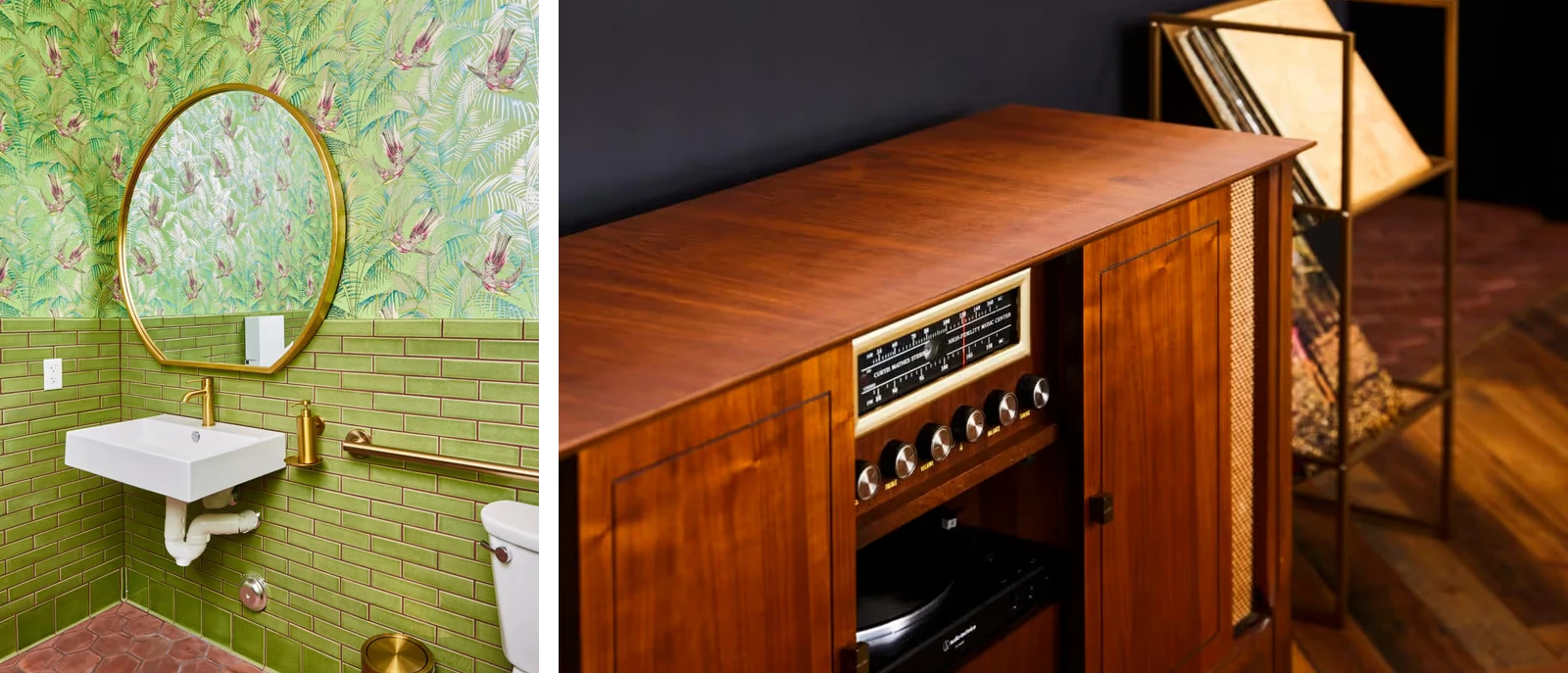
Perhaps it's the owner's grandmother's china. A local artist's work. A cocktail named after a neighborhood legend. A material chosen because it connects the restaurant to its surroundings. At HiFi Wines, a wine shop we designed in Merced, California, the owners' old hi-fi record player became the centerpiece of the room and the name on the door.
These aren't decorative afterthoughts.
They're opportunities to give guests something to discover, remember, and talk about.
Personality is what happens when design stops trying to please everyone.
The Both/And Era: Why Great Taste Loves Contradiction
Today's most culturally relevant restaurants increasingly reject traditional categories.
A Michelin-caliber meal in a casual dining room. Natural wine served alongside nostalgic comfort food. A neighborhood bar with the sophistication of a luxury hotel. A restaurant that feels both familiar and entirely new.
This is the Both/And Era.
Guests no longer need luxury to look formal, or casual to mean ordinary.
They want experiences that reflect their own contradictions.
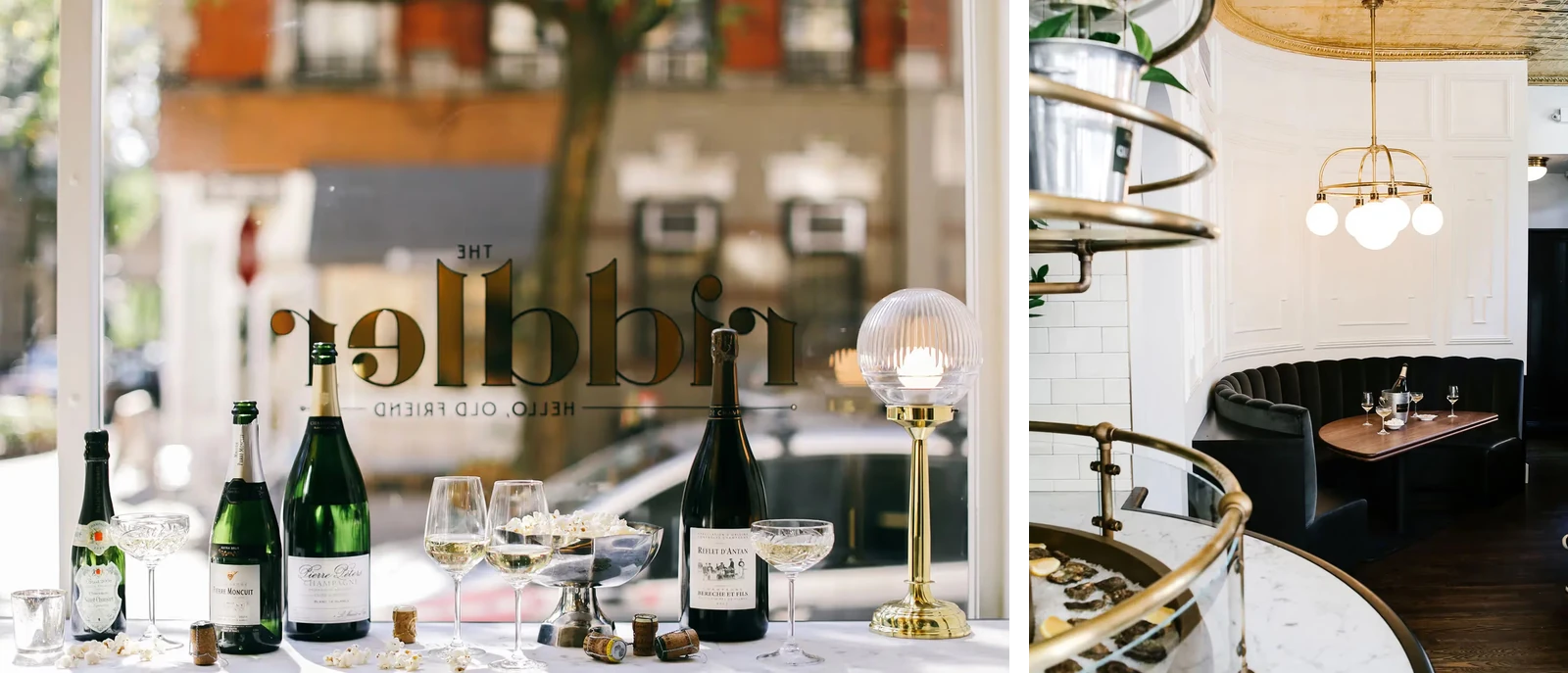
Consider the power of an inexpensive diner-style coffee mug sitting on a beautifully considered marble countertop. Or a highly technical dish served in an unpretentious room filled with laughter. At The Riddler in San Francisco and New York, caviar shares the menu with tater tot waffles, in rooms that borrow their manners from a Parisian bistro.
The contrast creates character.
And character creates connection.
For restaurant branding, this presents an opportunity to build identities that are more nuanced, playful, and culturally relevant.
Not everything needs to match.
But everything needs to make sense.
Why Taste Is a Business Strategy for Restaurants
Taste might sound subjective, but its business implications are tangible.
A restaurant with a distinctive point of view has a stronger foundation for recognition, storytelling, loyalty, and word of mouth.
Its identity is easier to remember because it doesn't look or sound like everyone else.
Its design can create signature moments that guests want to photograph and share.
Its personality can extend naturally into menus, merchandise, uniforms, programming, collaborations, and future locations.
And its atmosphere can give guests reasons to return that have nothing to do with what's on the plate.
For operators and developers, this raises a more useful question than simply, "How do we make this restaurant beautiful?"
What will make this restaurant matter to people?
The answer requires understanding the audience, the neighborhood, the food, the cultural context, and the emotional experience the restaurant wants to create.
It's why brand strategy and interior design shouldn't be separate conversations.
A beautiful restaurant might attract attention. A restaurant with taste has the potential to build affection.
And affection is what turns a first visit into a regular, a regular into an advocate, and a restaurant into an institution.
The Future of Hospitality Design Has Taste
As technology makes it easier to generate beautiful imagery, replicate aesthetics, and manufacture polished brand identities, the ability to create something genuinely distinctive becomes more important.
AI can produce a thousand mood boards in minutes.
It can suggest color palettes, write brand narratives, and generate images of restaurants that look extraordinary.
But a mood board isn't a point of view.
And a beautiful rendering isn't hospitality.
The real work is understanding the people who will inhabit the space. Their rituals, aspirations, contradictions, and desire to feel connected.
Taste requires judgment. Curiosity. Cultural fluency. Restraint. A willingness to make choices that aren't universally popular but are unmistakably right for the concept.
Technology can help us explore possibilities.
Human intelligence gives those possibilities meaning.
Questions Restaurateurs Ask About Restaurant Interior Design
How does interior design affect a restaurant's success?
Interior design shapes how long people stay, what they remember and whether they come back. Lighting, sound, seating and the way a room fills up all change how a meal feels. A room with a clear point of view also gives guests something to talk about, and that is where word of mouth starts.
Can a large restaurant still feel intimate?
Yes. Intimacy comes from proportion and detail more than square footage. Breaking a big room into smaller moments (a bar with its own light, a corner booth, a shift in ceiling height or material) lets a 200-seat restaurant feel like a neighborhood place.
Should restaurant branding and interior design be done together?
Yes, and as early as possible. The brand sets the personality and the space gives it physical form. Designed apart, you often end up with a logo and a room that feel like two different places. Designed together, the menu, signage, materials and service tell the same story.
The ROY POV: Good Taste Builds Great Restaurants.
At ROY, we believe the most compelling hospitality brands aren't necessarily the biggest, the most expensive, or the most fashionable.
They're the ones with something to say.
We approach restaurant branding and interior design as two expressions of the same idea, creating identities and environments that feel culturally relevant, emotionally resonant, and distinctly human.
Sometimes that means a jewel box filled with personality. Sometimes it means bringing intimacy, character, and soul to a much larger hospitality experience.
The scale changes. The philosophy doesn't.
Because great hospitality isn't about filling a room with beautiful things.
It's about filling a room with feeling.
And that's what we mean when we say good taste builds great restaurants.
ROY is a hospitality branding and interior design studio in San Francisco and New York, creating restaurant brands, spaces, and experiences people love. Explore Our Work